
- 2026-11-16 15:12:40 by Jan Raditya Pradipta
IULI Science Talk: Uncovering the Potential of Fermentation and Matcha for Healthy and Sustainable Food Innovation

Source: IULI Documentation.
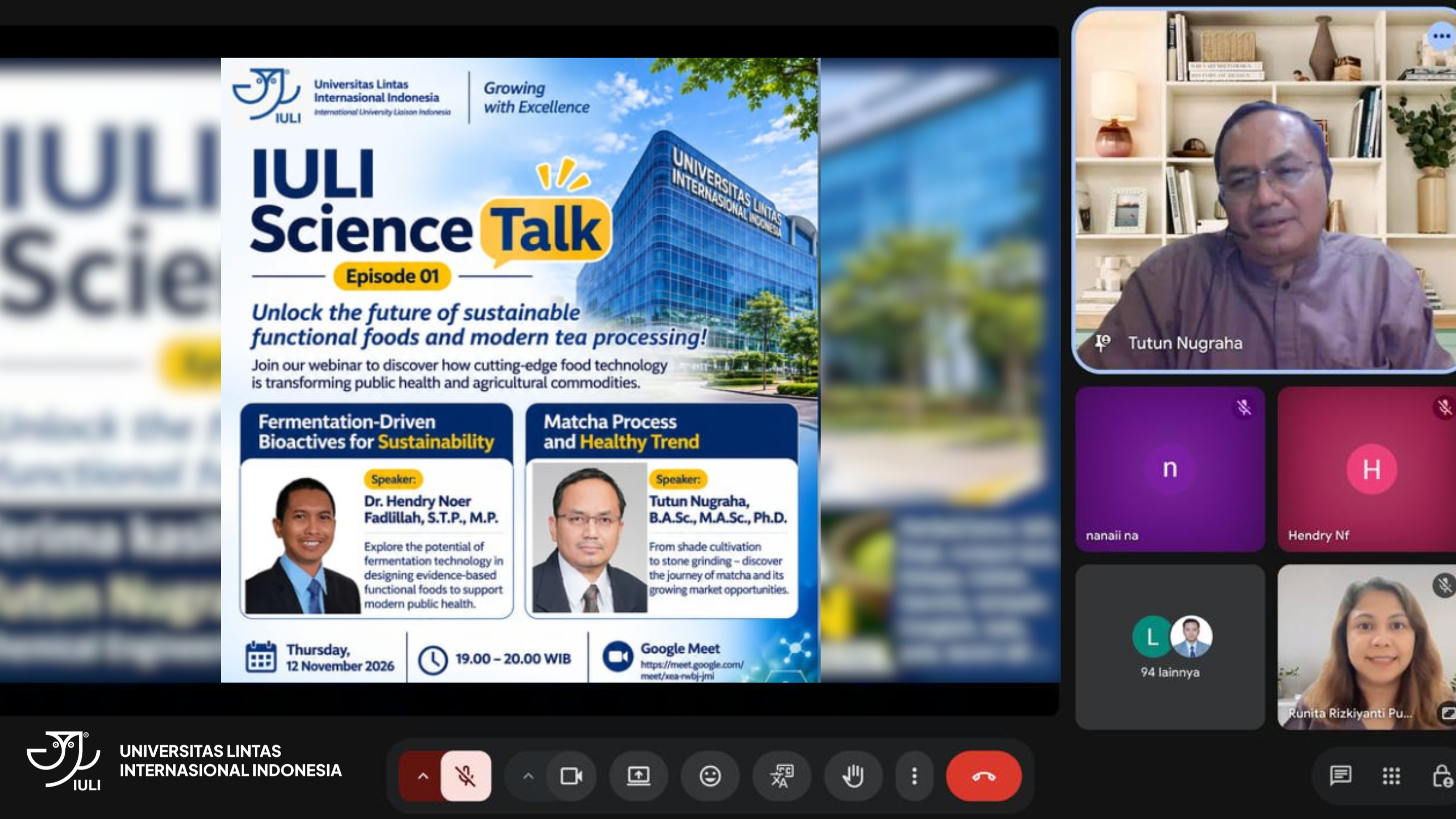
IULI Science Talk: Uncovering the Potential of Fermentation and Matcha for Healthy and Sustainable Food InnovationTANGERANG – International University Liaison Indonesia (IULI) has once again hosted an educational event through its "IULI Science Talk" program—a knowledge-sharing forum that connects academics with the younger generation to explore advancements in science and technology, as well as their practical applications. Held online on Thursday, November 12, 2026, the event featured two speakers: Dr. Hendry Noer Fadlillah, S.T.P., M.P., a lecturer in the Food Technology study program, and Tutun Nugraha, B.A.Sc., M.A.Sc., Ph.D., a lecturer in Chemical Engineering. The discussion was moderated by Runita Rizkiyanti Putri, S.T., B.Eng., M.Sc., a lecturer in Chemical Engineering at IULI.
The event saw high levels of enthusiasm from participating high school teachers and students. Active engagement—through various questions and discussions—made for a dynamic session, while also providing students with insight into how science evolves and is applied across different industrial sectors. In a session titled "Fermentation-Driven Bioactives for Sustainability," Dr. Hendry Noer Fadlillah highlighted the crucial role of fermentation technology in addressing global food crisis challenges—ranging from population growth and limited resources to high rates of food loss and food waste. Beyond simply extending shelf life or enhancing flavor, modern fermentation is now utilized as a bioprocess technology to improve food safety, increase the bioavailability of nutrients, and produce bioactive peptides rich in antioxidants. This scientific potential is also evident in the wealth of traditional Indonesian fermented foods, such as dadih (West Sumatra), dangke (Enrekang), and dali ni horbo (North Sumatra).
Dr. Hendry also clarified the common understanding of probiotics. Not all fermented foods are automatically probiotic; such products must contain an adequate number of live microorganisms and be proven to provide health benefits to the body. Ultimately, fermentation is more than just a traditional culinary heritage; it serves as a key to innovation for creating functional foods based on local resources, while simultaneously fostering a more environmentally friendly and sustainable food system.
Source: IULI Documentation.
In the second session, titled "Matcha Journey: Processes and Health Trends," Tutun Nugraha, B.A.Sc., M.A.Sc., Ph.D., explained that matcha is a high-value processed natural product. It represents a significant opportunity for the downstream development of Indonesia’s tea industry, which spans 100,000–120,000 hectares of land. Unlike regular green tea—where only the infusion is consumed—matcha is consumed as a powder made from the whole tea leaf. This ensures it retains a full spectrum of bioactive components—such as catechins, L-theanine, chlorophyll, fiber, and caffeine—that align with healthy lifestyle trends.
In terms of processing technology, the quality of matcha is largely determined by specific stages: shading the plants to increase levels of chlorophyll, L-theanine, and umami flavor; removing the stems and leaf veins from the leaf blade (lamina); and stone milling, which produces ultra-fine particles measuring 5–20 micrometers. Physical and chemical parameters—such as particle uniformity, suspension stability, green coloration, and the retention of active compounds—serve as key benchmarks that require the integration of chemical engineering principles and processing technologies.
By employing appropriate processing technologies, Indonesia’s local tea commodities hold significant potential for development into high-value-added matcha products. This downstreaming initiative not only paves the way for product innovation but also strengthens domestic resource-based industries and enhances the global competitiveness of Indonesian products. This activity is also part of the commitment of the International University Liaison Indonesia (IULI) to introduce higher education and scientific advancement to the younger generation. By featuring lecturers and academic practitioners as speakers, IULI aims to foster curiosity, critical thinking, and an interest among high school students in exploring the fields of science and technology.
The "IULI Science Talk" serves as a source of inspiration, demonstrating that science is not merely about theories confined to classrooms or laboratories; rather, it is about how knowledge can be applied to address real-world challenges and create a healthier, more innovative, and sustainable future.
News About "Teknologi Pangan, Teknik Kimia, IULI Science Talk:"
Other News

2026-11-16 15:12:40 by Jan Raditya Pradipta


2026-11-16 15:12:40 by Jan Raditya Pradipta

2026-11-16 15:12:40 by Jan Raditya Pradipta

2026-11-16 15:12:40 by Jan Raditya Pradipta